

black boys are scientists
on curiosity, composting, and shedding identity

On the table there are:
Flowers my girlfriend gave me two weeks ago. White mums and purple spiky sea holly. The mums are starting to brown and curl at the edges. The sea holly has softened, losing its once vibrant color.
Eggshells from the gooey fried egg I had over sticky noodles three days ago.
Slimy peppers, onions, and bok choy stems from the wonton soup I made during Columbia’s historic snow day last weekend.
These scraps have been building for about three weeks in my kitchen, and now they’re spread across someone else’s table, filling the room with the smell of decay despite my attempts to contain it with a trash bag.
I’m teaching a workshop to a group of teenage boys at Sowing Seeds into the Midlands today. It's a little after 4pm and raining, so we won't be working outside this evening. I'm a little nervous because these boys aren't exactly gardening enthusiasts. They're technically here to complete community service hours, but I know gardening has a way of winning over most anyone.
The ritual of growing—planting, watering, weeding, harvesting—teaches you that you have the capacity to make something from almost nothing with just a few seeds, soil, water, and sunlight. Knowing you don’t have to be dependent on corner store produce or fickle food supply chains is a form of liberation.
When you’ve got 400 quarts of greens and gumbo soup canned for the winter, nobody can push you around or tell you what to say or do.
Fannie Lou Hamer
As they make their way into the room, I ask if they've been enjoying gardening. The youngest stays silent but shakes his head no. The oldest just shrugs. It's their first time here, so neither of them is sure yet. But one of them admits he's been enjoying it, which gives me hope for an engaging workshop.
Courtney, my best friend and the Seeds garden coordinator, is already circling the table with her phone, ready to capture reactions. She's worked with some of these boys for months, creating space for them to fall in love with gardening. Teaching them how to plant collard greens, yes, but also how to practice patience, how to see themselves as caretakers, how to imagine futures where they're feeding their families from gardens they planted.
“We’re going to go through my trash today.”
The teens are still too cool to give me a laugh but my best friend indulges me before we move into the lesson.
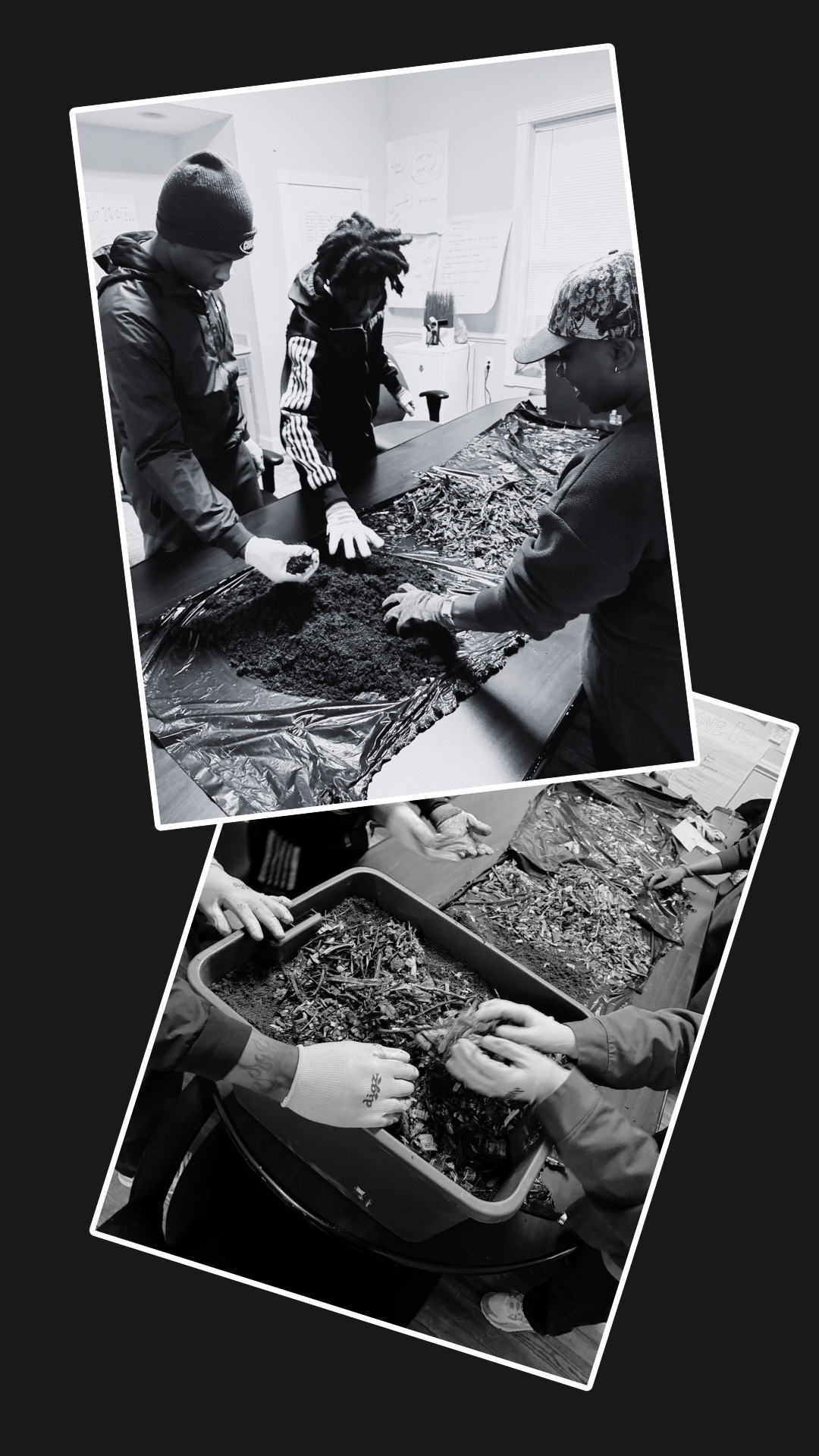
“Composting is the process of breaking down organic matter, like this stinky trash, into a natural fertilizer.” I point to the pile of finished compost at the far end of the table. “We’re going to mix this pile of browns and greens to make this dark, crumbly mixture that’s going to add nutrients to our soil and whatever we’re growing in it.”
The three boys are standing around the table at a careful distance.
“Don’t be afraid to get in there and touch it and smell it,” Courtney says, reaching into the pile. She mixes the top layer of wood chips, revealing the rich, earthy compost already maturing and heating up below. They move in closer. One of them reaches in, tentative at first, then more confident. Another leans over to smell it. I watch them light up as they realize that these brown chunks of wood and vegetable scraps are already transforming into compost.
“So this is like science?” one of the older boys observes aloud as he moves in closer to the makeshift compost bin.
I’ve hooked them.
wormholes
Wherever the soil is wasted the people are wasted. A poor soil produces only a poor people – poor economically, poor spiritually and intellectually, poor physically.
George Washington Carver, 1938
When I think about science, futuristic images always spring to my mind first. Lab coats, microscopes, cells under glass. In my dreams, science looks like space, the ocean, or the ingenuity of my ancestors navigating an oppressive world without modern technology. But in this room, at this table, science looks like curiosity and experimentation. It looks like three teenage boys leaning closer to inspect a bin of rotting vegetables.
I become a student right alongside them, learning from their questions and their hypotheses about what’s happening in the compost pile. How long does it take? What can’t go in here? What about meat? What about bones? What makes it hot? Can you do this in an apartment?
Every question is an experiment. Every answer is a wormhole leading to another question.
I watch their hands move through the compost and I think about what they may have carried into this space. What they’ve been told about themselves. What the world has decided they are. Boys who need correcting. Boys serving hours. And here they are, creating life from death. Learning that nothing is wasted.
What we’re actually doing here is alchemy. We’re taking what’s dead and we’re creating the conditions for it to transform into something that creates life. We’re learning that death isn’t an ending, it’s raw material for a new beginning.
Near the end of the workshop, I ask them: “Do you think you’ll garden when you’re older?”
One of the quieter boys doesn't hesitate. 'Yeah, I'll garden,' he says, voice full of conviction.
I believe him.
After the workshop, we sit around eating pizza as the boys leave one by one.
One of them can drive so he bounces at 5:30pm sharp. The other two scroll and catch up with their friends while waiting on their rides. The quiet one who said he’d garden one day is the last to leave. He’s heading home to play NBA 2K until it’s time for bed.
“Don’t be on there losing!” Courtney hollers after him.
He laughs one more time before saying goodnight.
“So this is like science?” has been rattling around my mind since the boys left.
These boys walked in here as community service kids. At least that’s what their paperwork says. But Courtney and the team at Seeds have created something else: a space where you can shed that. Where you can shed the titles of brother, son, or the kid who got in trouble. There’s trust here. There’s space to try on a new identity, even if just for a few hours.
George Washington Carver argued where the soil is wasted, the people are wasted. The inverse is also true. Where the soil is tended, the people flourish. Where young Black boys learn to create life from death, where their questions are called science, where nothing is wasted, I believe everything becomes possible.
This Substack made me tear up, they remind me so much of my students. For you to not only open your space with compassion, but to dedicate so much time and care into their futures is such a wonderful journey to read about. They will carry these lessons with them forever.
This is wonderful and important work! Black boys deserve to know that redemption and transformation is possible, especially when a lot of the times their mistakes or “garbage” is not their own fault. They deserve to have their questions and contributed honored, and I am glad you are making space for that to happen!